
Robert's Rules of Order for HOA Boards: A Practical 2026 Guide
A plain-English guide to Robert's Rules of Order for HOA boards — motions, seconds, debate, and voting — plus the common mistakes volunteer boards make and how procedure shapes the minutes.
Open almost any HOA's bylaws and you'll find a line saying board meetings will be governed by Robert's Rules of Order. Then you'll sit through a board meeting where nobody makes a formal motion, votes happen by vague consensus, and the secretary has no idea what to write down.
Robert's Rules has a reputation for being intimidating — the full manual runs well over 700 pages. But HOA boards don't need the full manual. They need a handful of core concepts, applied consistently. Get those right and meetings run smoothly, decisions are clearly made, and the minutes practically write themselves.
This is a practical, plain-English guide to the parts of Robert's Rules that actually matter for an HOA board — written for the community managers and board members who have to run real meetings.
Do HOA Boards Have to Follow Robert's Rules?
In most cases, yes — because your own bylaws say so.
Robert's Rules of Order is not a law. It's a widely adopted manual of parliamentary procedure. But the vast majority of HOA bylaws explicitly adopt Robert's Rules as the association's procedural authority. When the bylaws say it, following it is a governance obligation — and a board that ignores its own bylaws hands homeowners a legitimate complaint.
Two clarifications:
- Robert's Rules governs procedure; state law governs rights. Open meeting laws, notice requirements, and minutes rules come from statute — Robert's Rules can't override them. The two work together: state law says you must meet openly and keep minutes; Robert's Rules tells you how to run the meeting itself.
- HOA boards use a simplified version. The strict formality designed for large legislative bodies isn't necessary for a five-person board. Small boards are allowed more informality — but the core sequence of motion, second, and vote still applies.
If your bylaws adopt Robert's Rules, treat the concepts below as your operating manual. For the complete reference, see our full Robert's Rules of Order guide.
The Core Concepts Every HOA Board Needs
You can run a clean HOA board meeting with just these:
- Quorum — the minimum number of directors who must be present for the board to act. Without quorum, nothing the board "decides" is binding.
- Motion — a formal proposal to take a specific action. Board decisions happen through motions. "We should fix the pool gate" is a conversation; "I move that we approve the $1,800 quote from ABC Fence to repair the pool gate" is a motion.
- Second — another director's agreement that a motion is worth discussing. No second, no further action.
- Debate — the discussion that follows a seconded motion. The chair manages it so everyone is heard before anyone speaks twice.
- Vote — the board decides the motion. The result, and the count, are what go in the minutes.
- The chair — usually the board president, who runs the meeting, recognizes speakers, and keeps order without dominating the outcome.
That's the engine. Almost everything else in Robert's Rules is refinement.
How to Make and Handle a Motion
The motion is where Robert's Rules becomes concrete. The sequence:
- A director makes the motion. "I move that…" followed by a specific, complete proposal. Specificity matters — the motion's exact wording is what the board is voting on and what the minutes will record.
- Another director seconds it. "I second." This just means a second person thinks it's worth discussing. If there's no second, the motion dies and the meeting moves on.
- The chair states the motion. The chair restates it so everyone — including the secretary — is clear on exactly what's being decided.
- The board debates. Directors discuss; the maker of the motion usually speaks first. The chair keeps it orderly and on-topic.
- The chair calls the vote. "All in favor… opposed… abstentions."
- The chair announces the result. "The motion passes, four to one" — or fails. This announcement is what the secretary records.
A motion can also be amended (changed before the final vote) or tabled (set aside). Keep amendments simple — if a motion needs heavy reworking, it's often cleaner to withdraw it and make a new one.
Quorum, Voting, and What Counts as Passing
Quorum for an HOA board is set by the bylaws — usually a majority of directors. A five-member board generally needs three present. Check this line every meeting: if quorum isn't established and recorded, every action taken is open to challenge.
Voting. Most HOA board motions pass by a simple majority of those voting. Some actions — adopting certain rules, levying a special assessment — may require a higher threshold under the bylaws or state law. On a small board, the chair normally votes as a director.
Abstentions. A director may abstain. An abstention is not a "no" — it simply isn't a vote either way. But it should still be recorded, because the count of for, against, and abstain is part of the record.
Consensus is not a vote. "Everyone seems fine with that" is the single most common procedural failure on HOA boards. If the board is taking an action, take an actual vote and record an actual count.
Common Robert's Rules Mistakes HOA Boards Make
- Deciding things without a motion. The board talks, reaches a vague agreement, and moves on — and the secretary has nothing to record. Every decision needs a motion and a vote.
- Motions that are too vague. "Approve the landscaping" leaves everyone guessing later. State the vendor, the amount, and the scope.
- Skipping the second. Without a second, there's no motion to debate. Boards often debate first and formalize never.
- Letting debate run wild. The chair's job is to keep discussion orderly and bounded. Endless re-litigation is a chair problem.
- Not recording the vote count. "The motion passed" is weaker than "the motion passed 4–1." The count matters if a decision is ever questioned.
- Forgetting quorum. No quorum line in the minutes means every action that meeting is challengeable.
- Confusing Robert's Rules with the law. Procedure is Robert's Rules; open meetings, notice, and minutes retention are statute. Follow both.
How Procedure Shows Up in Your Minutes
Good procedure and good minutes are the same skill viewed from two angles. When a board runs on clean motions, the minutes have a clear structure to capture:
- the exact wording of each motion,
- who made and seconded it,
- the vote count (for / against / abstain), and
- the outcome.
When a board runs on vague consensus, the secretary is left guessing — and that guessing is where minutes errors and disputes come from. The discipline of Robert's Rules is what makes minutes accurate, and accurate minutes are what protect the board. For exactly what belongs in the record, see our HOA board meeting minutes guide.
How BoardBreeze Helps
Even a well-run meeting still has to be written up. BoardBreeze takes the meeting — notes or audio — and produces formatted minutes that capture each motion, second, vote count, and outcome in the structure Robert's Rules and state law expect.
The better your board's procedure, the better BoardBreeze's output: clear motions in, clean minutes out. The community manager reviews and approves instead of reconstructing the meeting from memory.
Robert's Rules isn't bureaucracy for its own sake. For an HOA board, it's the difference between decisions that are clearly made and provably documented — and decisions that can be argued about for months. Keep it simple: motion, second, debate, vote, record.
Ready to turn well-run meetings into clean minutes? Try BoardBreeze free.
Related HOA Resources
- HOA Board Meeting Minutes: 2026 Guide for Community Managers
- HOA Board Meeting Agenda: Template & Best Practices
- HOA Open Meeting Laws: A 2026 Compliance Guide
- HOA Board Meeting Minutes Requirements by State (2026)
- California HOA Laws: What Every Board Needs to Know in 2026
- HOA Meeting Minutes Software for Community Managers
BoardBreeze® is a proud CACM Industry Partner. CACM (California Association of Community Managers) is the leading professional organization for community association management professionals in California.
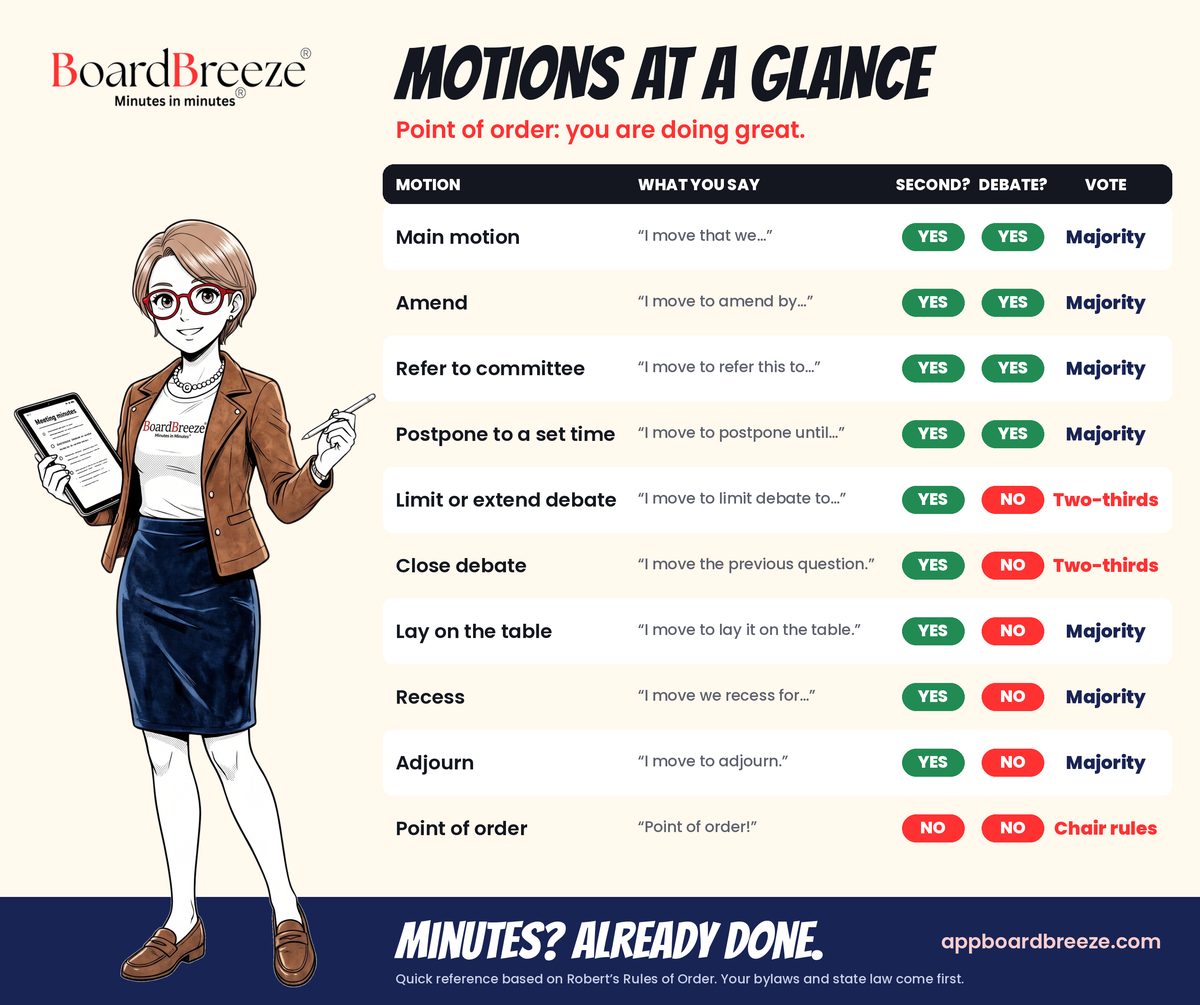
Motions at a Glance (free PDF)
Ten motions. Second, debate, and vote for each. One page.
The chart board clerks keep next to the keyboard for the moment the chair asks “does that need a second?” Based on Robert's Rules of Order. Your bylaws and state law come first.
BoardBreeze®
Stop Taking Minutes By Hand
BoardBreeze® converts your meeting audio into polished, compliant minutes automatically — no dedicated note-taker required.
Start Free 15-Day Trial →Ready to Automate Your Meeting Minutes?
BoardBreeze® turns your board meeting audio into polished, compliant minutes — Minutes in Minutes®, not hours.
Start Free TrialRelated Articles
HOA Board Meeting Agenda: Template, Order of Business & 2026 Best Practices
Build a compliant HOA board meeting agenda: the standard order of business, the consent agenda, executive session, and a free template. A 2026 guide for community managers.
HOA Annual Meeting Minutes: What to Record and How to Hit Quorum (2026)
What HOA annual meeting minutes must record — elections, member votes, proxies, and quorum — plus what to do when the meeting fails quorum. A 2026 guide for community managers.
HOA Board Meeting Minutes: Legal Requirements by State (2026)
What every state legally requires for HOA board meeting minutes - recording rules, distribution deadlines, and what creates liability. Free compliant template inside.