
Robert's Rules of Order for Meetings: Complete Guide for Board Secretaries
Robert's Rules of Order explained for board meetings: how to run a meeting step by step, how to record meeting minutes, motions and voting, quorum rules, and what to do when there is no quorum. Includes a free minutes template.
Quick answer: Robert's Rules of Order is the standard system of parliamentary procedure for running meetings in the United States. To run a meeting under Robert's Rules, follow the standard order of business (call to order, quorum check, approval of minutes, reports, unfinished business, new business, adjournment), transact all decisions by motion and vote, and record the minutes as a record of what was done, not what was said. This guide walks through each part, including a copy-paste meeting minutes template.
Parliamentary procedure might sound intimidating, but mastering Robert's Rules of Order transforms chaotic meetings into productive, legally defensible sessions. Whether you're leading a corporate board, managing a nonprofit, or organizing a community HOA, understanding these time-tested principles ensures every voice gets heard — and every decision gets properly recorded.
This guide covers the essentials of Robert's Rules of Order for meetings, with special attention to meeting minutes — the official record that proves your board followed proper procedure.
What Is Robert's Rules of Order?
Robert's Rules of Order is the standard guide for conducting organized meetings across America. Created by U.S. Army officer Henry Martyn Robert in 1876 (and regularly updated since), this framework establishes fair, efficient, and democratic decision-making procedures.
Henry Robert was embarrassed when asked to lead a public meeting without knowing parliamentary procedure, which prompted him to study the topic thoroughly. His experiences with wildly inconsistent meeting practices across different organizations inspired him to create a universal standard — one that continues to govern board meetings, city councils, HOAs, nonprofits, and school boards today.
At its core, Robert's Rules balances majority rule with minority rights, creating an environment where productive debate thrives while maintaining order and respect.
Core Principles of Robert's Rules
Four fundamental principles underpin every Robert's Rules meeting:
Majority Rule
Decisions reflect the will of the majority while protecting the minority's right to express dissenting views before the vote.
Equal Rights
Every member has identical privileges regarding participation, voting, and introducing business — the chair cannot silence a member simply because their views are unpopular.
Full Participation
The rules ensure everyone can contribute meaningfully to discussions without domination by vocal minorities or an overbearing chair.
Orderly Process
Systematic procedures prevent confusion and keep meetings focused on decisions rather than devolving into free-for-all debates.
Essential Components Every Board Leader Must Master
Quorum Requirements
A quorum is the minimum number of members needed to conduct official business. Without quorum, a board cannot make binding decisions. Most organizations require a simple majority of members (e.g., 4 of 7 board members), though specific requirements vary by bylaws.
If quorum is lost during a meeting — because members leave — the board must stop transacting business. Minutes should note when quorum was lost.
What If There Is No Quorum?
When a quorum never materializes, Robert's Rules permits exactly four actions and nothing else:
- Fix the time to which to adjourn (schedule an adjourned meeting to finish the business)
- Adjourn
- Recess (for example, to wait for late arrivals)
- Take measures to obtain a quorum (contact absent members)
Minutes should still be taken at a meeting without a quorum. Record that the meeting was called to order, the members present, the fact that a quorum was not present, and whichever of the four permitted actions the group took. Any substantive business conducted without a quorum is invalid unless the board later ratifies it at a properly constituted meeting, and the members who acted do so at their own risk.
Motion Procedures
Business is introduced through motions. The process:
- A member seeks recognition from the chair ("I move that...")
- Another member seconds the motion ("Seconded")
- The chair opens debate
- Members discuss
- The chair calls the vote
- The chair announces the result
Motions require a second before discussion begins. This two-person threshold prevents time being wasted on unpopular proposals that have no support.
Debate Guidelines
Structured debate ensures balanced discussion. Under standard Robert's Rules:
- Members may speak twice per motion (10 minutes each, unless the group sets shorter limits)
- The maker of the motion speaks first
- The chair alternates between supporters and opponents when possible
- Debate closes automatically when no member wishes to speak, or by a two-thirds vote to call the question
Voting Methods
| Method | When to Use |
|---|---|
| Voice vote ("Aye/Nay") | Routine motions with clear outcome |
| Show of hands | When the chair needs a count |
| Roll call vote | When a record of each member's vote is required (common for government boards) |
| Secret ballot | Sensitive matters, elections |
| Unanimous consent | Routine, uncontested items (saves time) |
How to Run a Meeting Using Robert's Rules of Order
If you are chairing a board meeting for the first time, the good news is that Robert's Rules gives you a ready-made script. The standard order of business is the agenda skeleton used by boards, councils, and associations everywhere:
- Call to order. The chair states: "The meeting will come to order." Note the time; it goes in the minutes.
- Roll call and quorum confirmation. The secretary records who is present and absent, and the chair confirms a quorum exists before any business is transacted.
- Approval of the previous meeting's minutes. The chair asks for corrections, then declares the minutes approved as presented or as corrected.
- Officer and committee reports. Treasurer's report, committee updates. Reports are received, not approved (with the exception of an auditor's report); a motion is only needed if a report contains a recommendation to act on.
- Unfinished business. Items carried over from the previous meeting, taken up in order. (Robert's Rules calls this "unfinished business," not "old business.")
- New business. New items are introduced by motion, seconded, debated, and voted on, one at a time.
- Announcements. Brief items that require no vote.
- Adjournment. A motion to adjourn is made and seconded, or the chair declares the meeting adjourned if there is no further business. Note the time for the minutes.
Two practical rules make this run smoothly. First, distribute the meeting agenda in advance, built on the order of business above, so members know what is coming and advance-notice items (bylaw amendments, budget approvals) are properly noticed. Second, the chair should announce each step aloud ("We are now on item 5, unfinished business"), which keeps the meeting on track and gives the secretary clean section breaks for the minutes.
For a board meeting agenda you can adapt, see our HOA board meeting agenda guide, which follows this same order of business.
Robert's Rules Meeting Minutes Template
Here is a minimal Robert's Rules meeting minutes template you can copy. It records everything the 12th edition requires and nothing it prohibits:
[ORGANIZATION NAME]
Minutes of the [Regular/Special] Meeting of the Board of Directors
[Date] at [Time], [Location]

CALL TO ORDER: The meeting was called to order at [time] by [name], [title].

MEMBERS PRESENT: [names]
MEMBERS ABSENT: [names]
A quorum was [present / not present].

APPROVAL OF MINUTES: Minutes of the [date] meeting were approved
[as presented / as corrected].

[AGENDA ITEM]:
  MOTION: [Exact wording of the motion]
  MOVED BY: [Name]   SECONDED BY: [Name]
  VOTE: [Carried X-Y / Failed X-Y / Unanimous]

EXECUTIVE SESSION: The board entered executive session at [time] to discuss
[stated reason] and reconvened in open session at [time].

ADJOURNMENT: The meeting was adjourned at [time].

Respectfully submitted,
[Name], Secretary
Repeat the agenda item block for each piece of business. If your board is a public body subject to an open meeting law, add a roll call vote listing each member's vote by name where your statute requires it.
Need a version tailored to your board type? Download our free board meeting minutes templates, 10 formats covering school boards (Brown Act), HOAs (Davis-Stirling and general state law), nonprofits, city councils, and advisory committees.
Robert's Rules and Meeting Minutes — What Must Be Recorded
This is where many boards get it wrong. Robert's Rules is very specific about what belongs in the minutes — and what doesn't.
What Minutes MUST Include
Under Robert's Rules, official minutes must contain:
- Type of meeting — regular, special, or emergency
- Name of the organization and presiding officer
- Date, time, and location of the meeting
- Quorum confirmation — whether a quorum was present
- Approval of previous minutes — "Minutes of the [date] meeting were approved as presented" (or "as corrected")
- All main motions — exact wording, who moved, who seconded, and the vote result
- All adopted secondary motions (postponements, referrals to committee, etc.)
- Points of order and appeals and how they were resolved
- Members present and absent (especially for government boards subject to open meeting laws)
- Adjournment time
What Minutes Must NOT Include
Robert's Rules is equally clear about what to leave out:
- The content of debate or what members said during discussion
- Minority opinions (unless a member formally requests their dissent be recorded)
- Personal commentary or the secretary's own observations
- A verbatim transcript — minutes are not a court transcript
"The minutes should contain a record of what was done at the meeting, not what was said by the members." — Robert's Rules of Order, 12th edition
This is the #1 mistake board secretaries make: recording a detailed account of the discussion instead of just the motion and vote. Detailed discussion records can actually create legal liability — courts have used discussion minutes against organizations in ways that a simple action record would have avoided.
How to Record a Motion Properly
Use this format for every motion in your minutes:
MOTION: [Exact wording of the motion as stated]
MOVED BY: [Member name]
SECONDED BY: [Member name]
VOTE: Carried [X-Y] / Failed [X-Y] / Unanimous
Example:
Motion to approve the proposed 2026 operating budget of $485,000 as presented. Moved by Director Chen. Seconded by Director Okafor. Vote: Carried 5-2.
That's it. No summary of why members supported or opposed it. No record of who argued for or against. Just the motion, the mover, the seconder, and the result.
Recording Roll Call Votes
For government boards (city councils, school boards, special districts) required by open meeting laws to record roll call votes, list each member's vote by name:
ROLL CALL VOTE on Motion to approve 2026 budget:
  Ayes: Chen, Okafor, Williams, Martinez, Thompson (5)
  Nays: Rodriguez, Kim (2)
  Absent: None
  Motion carried 5-2.
Executive Session Minutes
When a board goes into executive (closed) session, the minutes of the open meeting should note:
- The time executive session began
- The stated reason (e.g., "pending litigation," "personnel matter")
- The time the board reconvened in open session
Separate executive session minutes are kept confidential, recording only the actions taken (not the discussion). See your state's open meeting laws for specific requirements — California's Brown Act, Florida's Sunshine Law, and other state statutes each have distinct rules.
Approving Minutes Under Robert's Rules
At the start of each meeting, one of the first items of business is approving the previous meeting's minutes. The process:
- Chair asks: "Are there any corrections to the minutes of the [date] meeting?"
- Members offer corrections (if any)
- Corrections are accepted or rejected by majority vote
- Chair declares: "The minutes are approved as presented" (or "as corrected")
No formal motion to approve is required — the chair simply declares them approved after hearing corrections. However, some organizations' bylaws require a formal motion; check yours.
For a detailed walkthrough of the approval process, including how to handle disputed corrections and late-discovered errors, see our guide: How to Approve Board Meeting Minutes.
Robert's Rules for Virtual and Hybrid Board Meetings
Modern organizations have successfully adapted Robert's Rules for remote participation:
Virtual Recognition
Without a physical room, members use the "raise hand" function in video conferencing software, or simply state their name before speaking. The chair must be more deliberate about recognizing speakers to prevent cross-talk.
Electronic Voting
Most parliamentary authorities now accept electronic roll call votes via video conference. The secretary records each member's vote as stated verbally or through the platform's polling feature.
Hybrid Meeting Protocols
When some members attend in person and others participate remotely, the chair must ensure remote participants can hear all discussion, participate in debate, and cast votes. Many state open meeting laws now explicitly address hybrid participation — verify your jurisdiction's rules.
Electronic Voting Between Meetings
Some organizations use email or online voting for time-sensitive matters between meetings. Important: Robert's Rules traditionally requires a meeting for official business. Email votes are only valid if explicitly authorized by your bylaws. Check before relying on them.
Common Mistakes That Derail Meetings
Over-Rigid Application
Strict formality stifles small groups. Robert's Rules actually encourages small board rules for groups of 12 or fewer — members can speak without formal recognition, motions can be made without a second, and the chair can participate in debate. Most HOA and nonprofit boards qualify.
Inadequate Preparation
Distributing the agenda and supporting materials before the meeting is required for efficient Robert's Rules meetings. Motions that require advance notice (bylaw amendments, budget approvals) must be stated in the meeting notice — members can't vote on surprises.
Inconsistent Application
Selective rule enforcement breeds resentment and legal exposure. If the chair enforces debate limits on one member but not another, the board's decisions can be challenged. Apply rules uniformly.
Poor Minute-Taking
The most common failure. Board secretaries who record pages of discussion rather than clean motions and votes create confusion, legal liability, and painful review processes. If your board spends time at every meeting arguing over what the minutes "really say," the format needs to change.
How AI Can Help With Robert's Rules Meeting Minutes
Manually producing Robert's Rules-compliant minutes from a multi-hour board meeting is time-consuming and error-prone. AI meeting minutes software like BoardBreeze is purpose-built for board governance:
- Automatically identifies motions from audio and formats them correctly (motion, mover, seconder, vote)
- Omits discussion — generates concise summaries, not verbatim transcripts, matching Robert's Rules requirements
- Follows parliamentary structure — formats minutes with proper sections (call to order, approval of minutes, main business, adjournment)
- Supports compliance requirements — outputs plain text suitable for official records under open meeting laws
For a comparison of software options, see: Best Board Meeting Minutes Software.
Frequently Asked Questions
What does Robert's Rules say about meeting minutes?
Robert's Rules requires minutes to record official actions — motions, seconds, and vote results — not discussion. Minutes are a legal record of decisions, not a transcript of debate.
Who is responsible for taking minutes?
The secretary (or recording secretary) is responsible. In their absence, the presiding officer appoints a secretary pro tempore.
How do you record a motion in minutes?
Record the exact wording of the motion, the member who made it, the member who seconded it, and the vote result. Do not record the discussion that preceded the vote.
What should NOT be in board meeting minutes?
Content of debate, opinions expressed, and personal statements. Minutes record what was done, not what was said.
How do you approve minutes under Robert's Rules?
At the start of the next meeting, the chair asks for corrections. After corrections are handled, the chair declares the minutes approved — no formal motion required unless your bylaws say otherwise.
Can AI software help with Robert's Rules meeting minutes?
Yes. Tools like BoardBreeze automatically identify and format motions, seconds, votes, and action items from audio recordings, producing minutes that follow the Robert's Rules format without manual transcription.
How do you run a meeting using Robert's Rules of Order?
Follow the standard order of business: call to order, roll call and quorum confirmation, approval of the previous minutes, reports, unfinished business, new business, announcements, and adjournment. All decisions are made by motion, second, debate, and vote.
Can a board hold a meeting without a quorum?
No substantive business is valid without a quorum. The only permitted actions are to fix the time to which to adjourn, adjourn, recess, or take measures to obtain a quorum. Minutes should still record that the meeting convened and that a quorum was not present.
Is there a Robert's Rules meeting minutes template?
Yes, see the copy-paste template earlier in this guide, or download one of our 10 free board meeting minutes templates adapted to specific board types and meeting laws.
Getting Started
You don't need to implement everything at once. Start with the basics:
- Introduce motions and seconds — even if informally. Stop decisions from being made by whoever speaks loudest.
- Fix your minutes format — stop recording discussion. Start recording motions and votes only.
- Establish quorum rules — know your number and enforce it.
- Agenda distribution — send it 48–72 hours before the meeting.
As comfort grows, add more structure. The goal is meetings that are fair, efficient, and legally defensible — not meetings that feel like a courtroom.
Related Reading
- Board Meeting Minutes: The Complete 2026 Guide
- How to Write Board Meeting Minutes
- What to Include in Board Meeting Minutes (Checklist)
- How to Approve Board Meeting Minutes
- Robert's Rules vs Commonwealth Meeting Procedures
- Best Board Meeting Minutes Software 2026
- Committee Meeting Minutes for California Community Colleges
- Free Board Meeting Minutes Templates (10 Board Types)
- Ordinance vs. Resolution vs. Motion: A Clerk's Guide
Ready to eliminate the manual work of meeting minutes? BoardBreeze turns your board meeting audio into Robert's Rules-compliant minutes automatically: motions formatted correctly, discussion omitted, action items extracted. Start your free trial, no credit card required.
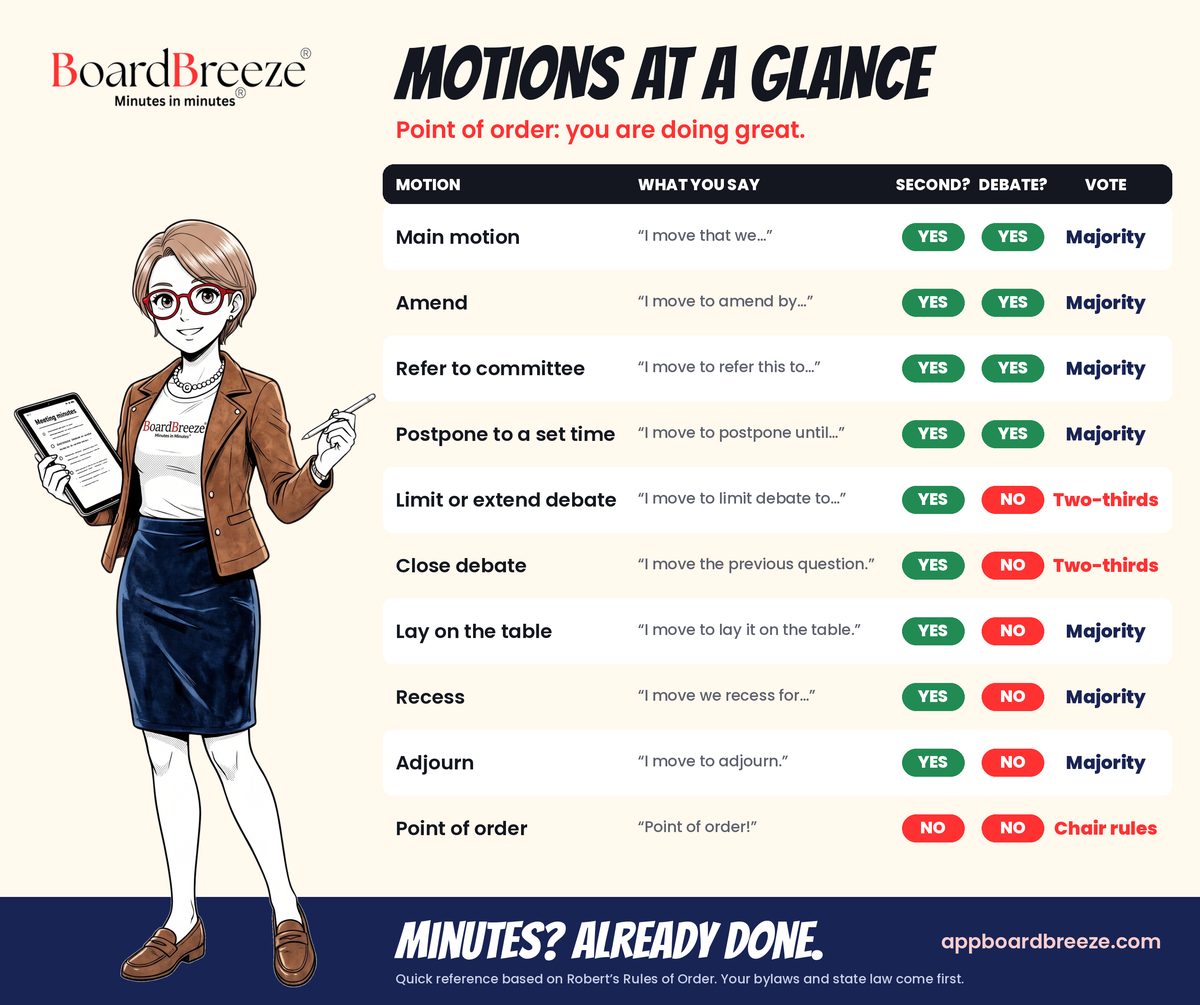
Motions at a Glance (free PDF)
Ten motions. Second, debate, and vote for each. One page.
The chart board clerks keep next to the keyboard for the moment the chair asks “does that need a second?” Based on Robert's Rules of Order. Your bylaws and state law come first.
BoardBreeze®
There's a Better Way to Handle Meeting Minutes
BoardBreeze® uses AI to turn audio recordings into formatted, compliant minutes in minutes, not hours.
See How It Works →Ready to Automate Your Meeting Minutes?
BoardBreeze® turns your board meeting audio into polished, compliant minutes — Minutes in Minutes®, not hours.
Start Free TrialRelated Articles
Ordinance vs. Resolution vs. Motion: What Every City Clerk Needs to Know (2026)
The practical difference between an ordinance, a resolution, and a motion: what each one does, how each is adopted, when each takes effect, and exactly how each should appear in your council minutes.
Committee Meeting Minutes for California Community Colleges: Participatory Governance, Robert's Rules & the Brown Act
Every California community college runs ten or more governance committees — accreditation, budget, facilities, PGC — and each one needs minutes. What committee minutes must include, how the Brown Act applies, why accreditation teams read them, and how to produce them in minutes instead of hours.
Approval of Board Meeting Minutes: Rules & Process
Learn the correct process for approval of board meeting minutes, including Robert's Rules, amendments, corrections, consent agendas, and common mistakes.