
HOA Board Meeting Minutes: Legal Requirements by State (2026)
What every state legally requires for HOA board meeting minutes - recording rules, distribution deadlines, and what creates liability. Free compliant template inside.
HOA board meeting minutes are legally required in every state, but the rules differ: most states set a deadline to draft and distribute minutes, require an accurate record of motions and votes, and treat the minutes (not a recording) as the official record. Below is what each state requires, with deadlines and liability notes.
Start your free BoardBreeze trial → — generate compliant HOA board minutes from your next meeting recording in about 20 minutes, with a free template to match.
HOA board meeting minutes are not just administrative paperwork. They are legally required records under state law, and the requirements vary significantly depending on where your association is located.
California's rules are among the most detailed in the country. Florida, Texas, and Nevada have their own specific statutory frameworks. And in states without specific HOA legislation, general corporate law or nonprofit law governs what minutes must contain.
This guide covers the legal requirements for HOA board meeting minutes in the 12 states with the largest HOA populations, plus general principles that apply everywhere.
If you'd rather have HOA meeting minutes software handle these state-by-state compliance differences for you, BoardBreeze produces minutes that satisfy California, Florida, Texas, and Nevada requirements out of the box — and automatically deletes the audio so you only keep the official record.
Quick Reference: HOA Minutes Deadlines by State (2026)
How quickly your association must make board meeting minutes available to members, by state. Always confirm against the current statute — deadlines and citations can change.
| State | When minutes must be available | Governing statute |
|---|---|---|
| California | Within 30 days of the meeting | Civ. Code §4950 |
| Florida | Within 10 business days of a written records request | Fla. Stat. §720.303(5) |
| Texas | Within 10 business days of a written request (certified mail); extendable up to 15 more with written notice | Prop. Code §209.005(e) |
| Nevada | Within 30 days of the meeting (minutes or a summary) | NRS 116.3108; NRS 116.31083 |
| Arizona | Within 10 business days of a written request | A.R.S. §33-1805 |
| Washington | Request acknowledged within 10 business days; fulfilled within 21 business days | RCW 64.90.495 (WUCIOA) |
| Colorado | Inspection within 30 calendar days of a written request sent certified mail — $50/day penalties can start on the 11th business day | C.R.S. §38-33.3-317(4.5) |
| Illinois | Response to a written request within 30 days (silence is deemed a denial) | 765 ILCS 160/1-30(i) |
| Georgia | No association-side production deadline in the POA Act; member inspection runs through the Nonprofit Code — written demand at least 5 business days before the inspection date | O.C.G.A. §14-3-1602 |
| North Carolina | Records "reasonably available"; inspection demands require at least 5 business days' written notice (Nonprofit Act) | G.S. §47F-3-118; §55A-16-02 |
| New York | Member-meeting minutes: inspection on 5 days' written demand (member of record ≥6 months); board minutes are NOT statutorily inspectable on demand | N-PCL §621 / BCL §624 |
| Ohio | Per the association's governing documents — no statutory day count | O.R.C. §5312.07 |
The pattern: a few states tie the clock to the meeting date (California and Nevada — 30 days); several tie it to a member's written request (Florida, Texas, Arizona, Washington, Illinois — typically 10–30 business days, plus Colorado's 30-calendar-day backstop with daily penalties); and the rest impose no association-side production deadline at all, relying on corporate-law inspection mechanics or the governing documents (Georgia, North Carolina, New York, Ohio). No state in this table currently requires HOA minutes to be posted on a website — Florida's and Nevada's website/portal statutes both omit minutes from their required-document lists. Either way, the practical takeaway is the same: minutes that are ready within hours of the meeting clear every one of these deadlines with room to spare.
Full requirements — content, executive session rules, and retention — for each state below.
General Requirements (All States)
Before covering state-specific requirements, these baseline requirements apply in virtually every jurisdiction:
Written minutes are required. Every board meeting — including special meetings and emergency meetings — must have written minutes. Verbal records do not satisfy the legal requirement.
Minutes must be kept permanently. Board meeting minutes are corporate records of the association. They must be retained permanently or for a substantial minimum period (most states: 7 years minimum, many: permanently).
Executive session minutes are separate and confidential. When boards convene in closed session for permitted topics, those minutes are kept separately and are not subject to member inspection — but the fact that an executive session occurred must appear in the open session record.
Members have inspection rights. In nearly every state, HOA members have a statutory right to inspect board meeting minutes upon request, subject to reasonable time and notice requirements. For public bodies governed by open meetings laws, the access rules go further — see are board meeting minutes public for how disclosure works under the Brown Act and other state statutes.
California
Governing law: California Civil Code §4900–4955 (Davis-Stirling Common Interest Development Act)
Open meeting requirement: Board meetings must generally be open to members (§4925). Members may observe and address the board during open forum periods.
Minutes requirement: The board must keep written minutes of all board meetings (§4950).
Availability timeline: Minutes must be available to members within 30 days of the meeting (§4950). If a member requests minutes, the association must provide them within 30 days.
Executive session: Permitted for litigation, formation of contracts with third parties, personnel matters, delinquency, and other specified purposes (§4935). Executive session minutes are separate and not available to members, except that actions taken in executive session that can be disclosed must be noted in the open session minutes.
Content requirements: Minutes must include at minimum: date, time, location, members present, and all actions taken. Roll call or voice votes must be recorded. Any vote to go into executive session must be noted.
Unique requirement: California requires that the notice of each meeting and the agenda be posted in a prominent location accessible to members at least 4 days before the meeting (§4920) — and the minutes must reflect that this was done.
Retention: Minutes are part of the association's official records and must be retained permanently (§5200).
Florida
Governing law: Florida Statutes Chapter 720 (Homeowners' Associations) or Chapter 718 (Condominiums)
Open meeting requirement: Board meetings must be open to all members (§720.303(2)). Members may not be prevented from attending or recording meetings (with notice).
Minutes requirement: The board must maintain minutes of all board meetings (§720.303(4)).
Availability timeline: Minutes are official records that must be made available for inspection or copying within 10 business days of a member's written request (§720.303(5)). Chapter 720 does not impose a production deadline tied to the meeting or to approval. (The posting rules people sometimes remember are from the condominium statute, Chapter 718 — a different law that does not apply to HOAs.)
Recording meetings: Florida explicitly permits members to record board meetings (video or audio) unless the board adopts reasonable written notice requirements for recording devices. Recording equipment may not be used in ways that disrupt the meeting.
Executive session: Permitted for pending litigation, and in some circumstances for personnel matters. All votes on emergency matters taken outside a meeting must be ratified at the next meeting.
Content requirements: Minutes must reflect all motions and votes taken. Roll call or voice votes must be noted. Florida requires specific disclosure of conflicts of interest in condominium association proceedings.
Retention: Minutes must be retained for at least 7 years (§720.303(4)).
Texas
Governing law: Texas Property Code Chapter 209 (Planned Communities) and Chapter 82 (Condominiums)
Open meeting requirement: Regular and special board meetings must be open to owners (§209.0051(c)). Since SB 1588 (effective Sept 1, 2021), posted or emailed notice is required at least 144 hours before a regular board meeting and 72 hours before a special board meeting (§209.0051(e)); mailed notice may alternatively be given 10–60 days before.
Minutes requirement: The board must keep written minutes of each regular or special meeting and make them available for inspection and copying on written request (§209.0051(d)).
Availability timeline: Members may request minutes in writing by certified mail, and the board must schedule inspection or produce copies within 10 business days (§209.005(e)) — extendable by up to 15 additional business days with written notice. The board may charge copying fees only if it has adopted and recorded a records production and copying policy as a dedicatory instrument (§209.005(i)).
Meetings continued or held without notice: If a board meeting is adjourned and continued, notice of the continuation must be given within 2 hours after adjournment (§209.0051(g)). Certain actions taken without prior notice under §209.0051(h) must be summarized orally and documented in the minutes of the next regular or special board meeting — there is no separate "emergency meeting" provision in the statute.
Executive session: Permitted for pending litigation, enforcement, personnel, and contract negotiation matters. The board must convene in open session first, then convene the executive session, then reconvene in open session to take any vote required.
Content requirements: Minutes must include all actions taken, motions and votes, and any significant governance decisions. The Texas HOA statute does not specify a detailed format, but general corporate record-keeping standards apply.
Nevada
Governing law: Nevada Revised Statutes Chapter 116
Open meeting requirement: Board meetings must be open to members. Notice of board meetings must be given at least 10 days in advance, with the agenda included (NRS 116.31083(2), (5)); meetings of the units' owners require 15 to 60 days' notice with the agenda (NRS 116.3108(3)).
Minutes requirement: Each board meeting must be audio-recorded and minutes taken; the minutes, recording, and a summary must be made available to owners (NRS 116.31083(8)).
Availability timeline: Minutes (or a summary) of member meetings must be made available within 30 days of the meeting (NRS 116.3108(6)); board-meeting minutes and the required audio recording must be provided within 30 days on request, with electronic copies free of charge (NRS 116.31083(8)).
Executive session: Permitted for attorney-client privilege, personnel, delinquency, and contract matters. The board must announce the topic of executive session before convening (NRS 116.31083).
Unique requirement: Nevada is one of the few states that statutorily requires board meetings to be audio-recorded, with electronic copies of the recording provided to owners free of charge (NRS 116.31083(8)).
Arizona
Governing law: Arizona Revised Statutes §33-1804 (open meetings) and §33-1805 (association records) for planned communities; §33-1248 (Condominiums)
Open meeting requirement: All meetings of the association, the board, and regularly scheduled committees are open to all members (§33-1804(A)). After declarant control ends, notice of board meetings and agendas must be given at least 48 hours in advance (§33-1804(D)).
Minutes requirement: Arizona's planned-community statute does not impose a general minutes-drafting mandate; its only explicit minutes rule is for emergency meetings, whose minutes must state the reason necessitating the emergency and be read and approved at the next regular board meeting (§33-1804(E)). Any minutes the association keeps are association records subject to member examination under §33-1805.
Availability timeline: Open-session minutes are association records that must be reasonably available for member examination; copies must be provided within 10 business days of a written request, at no more than 15 cents per page (§33-1805(A)). Executive-session minutes may be withheld (§33-1805(B)(3)).
Executive session: Permitted for attorney consultation, personnel, and enforcement matters. The subject matter of executive session must be announced before the board convenes.
Washington
Governing law: Washington Uniform Common Interest Ownership Act (WUCIOA), RCW 64.90. The former HOA minutes statute, RCW 64.38.035, was repealed effective January 1, 2026, and WUCIOA's meeting provisions now apply to legacy HOAs (the full Chapter 64.38 repeal takes effect January 1, 2028).
Open meeting requirement: Board meetings must be open to unit owners except during executive sessions (RCW 64.90.445(2)(a)), with notice at least 14 days in advance (RCW 64.90.445(2)(f)).
Minutes requirement: Minutes of all board meetings must be kept as official records.
Availability timeline: Minutes are association records under RCW 64.90.495: a member's records request must be acknowledged within 10 business days and fulfilled within 21 business days.
Executive session: Permitted for litigation, contract negotiation, personnel, and delinquency matters.
Colorado
Governing law: Colorado Common Interest Ownership Act (CCIOA), C.R.S. §38-33.3-308
Open meeting requirement: All regular and special board and committee meetings must be open to all members (§38-33.3-308(2)(a)), and §38-33.3-308(2.5)(a) makes meetings open notwithstanding anything to the contrary in the governing documents.
Minutes requirement: Minutes of all meetings of the unit owners and the executive board must be maintained as association records (§38-33.3-317(1)(c)).
Availability timeline: Since HB 21-1229 (effective Sept 7, 2021), Colorado has real teeth: if a written records request is sent by certified mail (return receipt requested), the association must allow inspection or copying within 30 calendar days — failure triggers penalties of $50 per day starting on the 11th business day after receipt, capped at the greater of $500 or actual damages (§38-33.3-317(4.5)). The association may also require a written request at least 10 days before inspection (§38-33.3-317(2)(a)).
Executive session: Permitted for legal matters, personnel, and contract negotiations; the minutes must note that an executive session was held and its general subject matter (§38-33.3-308(7)).
Illinois
Governing law: Illinois Common Interest Community Association Act (765 ILCS 160) and Condominium Property Act (765 ILCS 605)
Open meeting requirement: Board meetings must be open to any unit owner, with enumerated closed-session exceptions such as litigation, personnel, and unpaid assessments (765 ILCS 160/1-40(b)(5)); votes on those matters must still be taken in open session. Very small associations (10 or fewer units, or annual budgeted assessments of $50,000 or less) are exempt from parts of the Act.
Minutes requirement: Minutes of all board meetings must be maintained for at least 7 years (765 ILCS 160/1-30(i)).
Availability timeline: Records — including minutes — must be made available for member examination and copying; on a written request, failure to provide the record or respond within 30 days is deemed a denial by the board (765 ILCS 160/1-30(i)). Note that Illinois condominiums are governed separately (765 ILCS 605/19, with a 10-business-day response rule) — don't mix the two regimes.
Common practice note: Approving or correcting draft minutes at the next board meeting is standard parliamentary practice under Robert's Rules of Order for meetings, but it is not a requirement written into the Illinois statute.
Georgia
Governing law: Georgia Property Owners' Association Act (O.C.G.A. §44-3-220 et seq.)
Open meeting requirement: The POA Act contains no explicit open-board-meeting mandate comparable to California's or Texas's — meeting-access practices in Georgia are typically set by the association's declaration and bylaws, so check your governing documents.
Minutes requirement: The POA Act itself has no dedicated minutes section. Because Georgia POAs must be incorporated (§44-3-227), record-keeping and inspection run through the Georgia Nonprofit Corporation Code.
Availability timeline: Under O.C.G.A. §14-3-1602, a member must deliver a written demand at least 5 business days before the desired inspection date. Minutes of member meetings from the past 3 years are inspectable as of right; minutes of board meetings are available only as excerpts and only if the member shows a good-faith proper purpose described with reasonable particularity (§14-3-1602(c)–(d)). There is no 10-business-day production deadline in Georgia law.
North Carolina
Governing law: North Carolina Planned Community Act (G.S. §47F) and Condominium Act (G.S. §47C)
Open meeting requirement: Board meetings must be open to members with reasonable notice.
Minutes requirement: Minutes of all board meetings must be maintained as official records (§47F-3-118).
Availability timeline: Meeting records must be made "reasonably available for examination" per the bylaws and the Nonprofit Corporation Act (G.S. §47F-3-118(a)). The incorporated Nonprofit Act requires the member's written demand at least 5 business days before the desired inspection date (G.S. §55A-16-02) — a member-side notice period, not an association production deadline; board minutes are available as excerpts subject to a proper-purpose showing.
New York
Governing law: New York Business Corporation Law (for HOA corporations) and Nonprofit Corporation Law; condominium buildings governed by Real Property Law §339-v
Open meeting requirement: New York does not have a statewide HOA open meeting statute comparable to California or Florida. Individual HOA bylaws govern meeting openness.
Minutes requirement: The corporation must keep minutes of the proceedings of its members, board, and executive committee (N-PCL §621(a); BCL §624(a) for business-corporation HOAs).
Availability timeline: The statutory inspection right is narrower than most assume: a member of record for at least 6 months may, on at least 5 days' written demand, inspect the minutes of member proceedings and the membership list (N-PCL §621(b)) — board minutes are not statutorily inspectable on demand (broader access, if any, comes from common-law proper-purpose rights or the governing documents).
Note: New York HOA law is significantly less standardized than California or Florida. Rights and requirements depend heavily on the specific HOA's bylaws and corporate documents.
Ohio
Governing law: Ohio Planned Community Law (ORC §5312) and Condominium Act (ORC §5311)
Open meeting requirement: Ohio is an important exception: planned-community board meetings are not required by statute to be open to owners. ORC §5312.04 provides that no owner other than a director may attend or participate in board meetings unless the board expressly authorizes it — board meetings are closed by default. Many Ohio associations' own declarations or bylaws voluntarily provide for open meetings, but that is a governing-documents choice, not a statutory right.
Minutes requirement: The association must keep minutes of association and board meetings among its records (ORC §5312.06(C)(3)).
Availability timeline: Ohio statute sets no specific day-count deadline. Owners may examine and copy books, records, and minutes pursuant to reasonable standards set forth in the declaration, bylaws, or rules (ORC §5312.07) — the response timeline, if any, comes from your association's governing documents.
What Every HOA Minutes Record Should Include
Regardless of state, these elements should appear in every set of HOA board meeting minutes to satisfy legal requirements and protect the board:
Header: Association name, meeting type (regular, special, emergency), date, time, location.
Attendance: Names of all board members present and absent. Confirmation of quorum. Names of any members of the public or management company staff present.
Approval of prior minutes: Motion, vote, and outcome.
Each agenda item: Brief summary of any presentation or discussion. Any motion in its exact wording (not paraphrased). Who moved and seconded. Vote count and outcome.
Public forum: In open meeting states, note who addressed the board and the general topic.
Action items: Every task assigned — what, who, when.
Executive session entry and exit: If the board convened in executive session, note this in the open session record: when it began, the general subject, when open session reconvened, and any actions taken that can be disclosed.
Adjournment: Time of adjournment and next scheduled meeting.
Producing Compliant HOA Minutes
The challenge for most HOA boards is consistency. State law sets the requirements; producing minutes that reliably meet those requirements at every meeting — especially under time pressure — is where boards fall short.
AI minutes software addresses both problems. BoardBreeze processes a meeting recording and produces formatted minutes in 15-20 minutes, organized by agenda item, with motions captured verbatim, votes recorded, and action items extracted. The output satisfies the content requirements that state law imposes.
For California boards: the output format addresses Davis-Stirling requirements and the 30-day availability clock. For Florida and Texas boards: the 10-business-day response deadline on member records requests becomes trivially easy to meet when minutes are available within hours of the meeting.
For more on HOA-specific minutes requirements, see our HOA board meeting minutes guide and HOA meeting minutes software guide.
Try BoardBreeze free — upload a recording from your most recent HOA board meeting and see compliant minutes before your next meeting.
Further Reading
- HOA Board Meeting Minutes Guide
- HOA Annual Meeting Minutes: Quorum, Proxies & Elections
- Best HOA Meeting Minutes Software 2026
- California HOA Laws: What Every Board Needs to Know
- Open Meeting Law Compliance for HOAs
- Open Meeting Laws by State: 2026 Compliance Guide
- Are Board Meeting Minutes Public?
- Board Meeting Minutes Format: Complete Guide + Templates
- Robert's Rules of Order for Meetings: Complete Guide
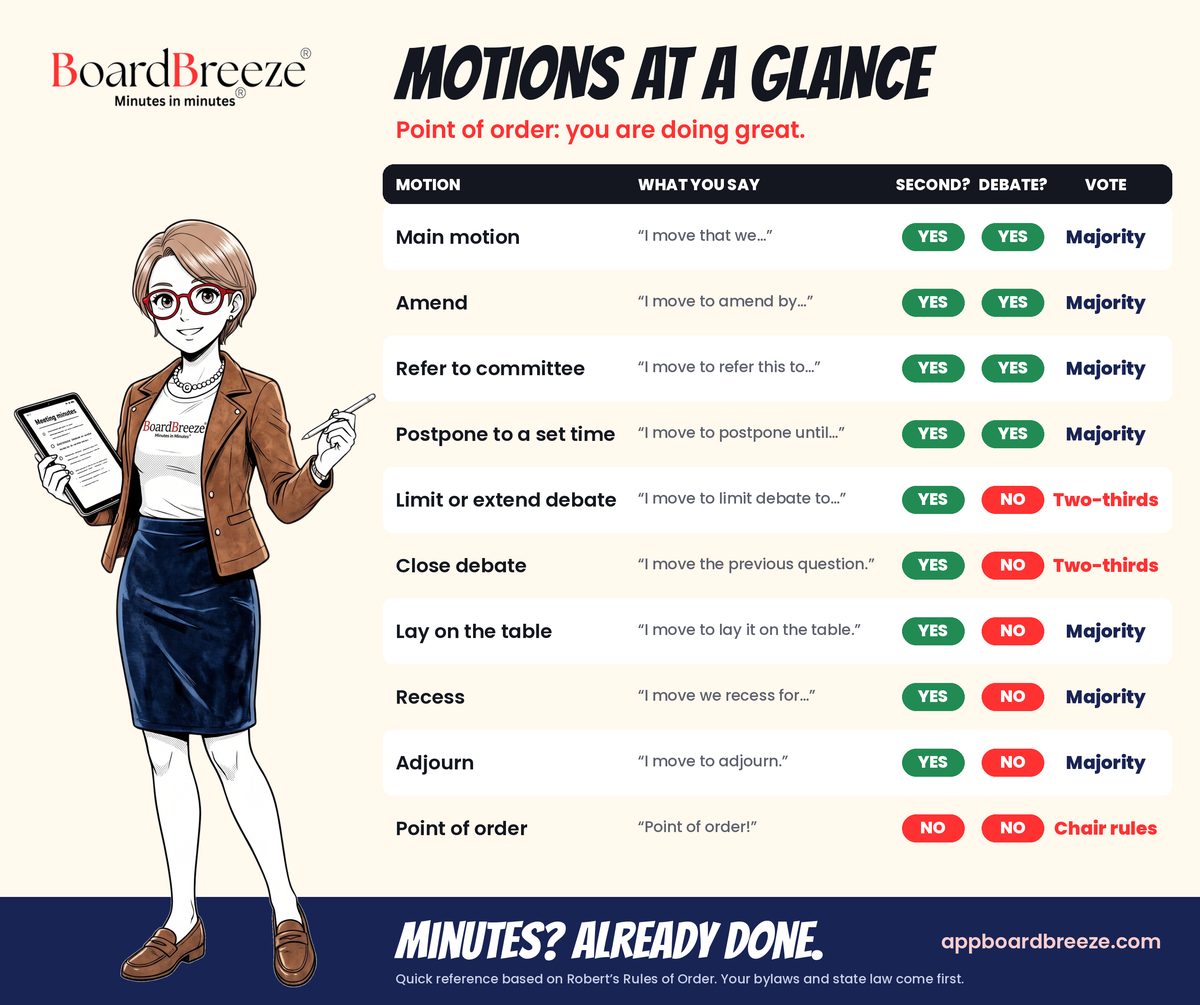
Motions at a Glance (free PDF)
Ten motions. Second, debate, and vote for each. One page.
The chart board clerks keep next to the keyboard for the moment the chair asks “does that need a second?” Based on Robert's Rules of Order. Your bylaws and state law come first.
BoardBreeze®
Stop Taking Minutes By Hand
BoardBreeze® converts your meeting audio into polished, compliant minutes automatically — no dedicated note-taker required.
Start Free 15-Day Trial →Ready to Automate Your Meeting Minutes?
BoardBreeze® turns your board meeting audio into polished, compliant minutes — Minutes in Minutes®, not hours.
Start Free TrialRelated Articles
Robert's Rules of Order for HOA Boards: A Practical 2026 Guide
A plain-English guide to Robert's Rules of Order for HOA boards — motions, seconds, debate, and voting — plus the common mistakes volunteer boards make and how procedure shapes the minutes.
HOA Board Meeting Agenda: Template, Order of Business & 2026 Best Practices
Build a compliant HOA board meeting agenda: the standard order of business, the consent agenda, executive session, and a free template. A 2026 guide for community managers.
HOA Annual Meeting Minutes: What to Record and How to Hit Quorum (2026)
What HOA annual meeting minutes must record — elections, member votes, proxies, and quorum — plus what to do when the meeting fails quorum. A 2026 guide for community managers.