
Approval of Board Meeting Minutes: Process, Motion Language & Common Mistakes
The complete process for approving board meeting minutes — exact motion language, Robert's Rules requirements, executive session handling, and the mistakes that create legal exposure.
Every board meeting follows a rhythm: call to order, old business, new business, adjournment. But tucked into that agenda is a step that many boards rush through — the approval of board meeting minutes from the previous meeting.
It might seem like a formality. It is not.
Approved minutes are the official legal record of what your board decided. They are what auditors review, what courts reference, and what new board members read to understand past decisions. Getting the approval process right matters more than most people realize.
This guide walks through everything you need to know about approving board meeting minutes — from the standard process under Robert's Rules of Order to common pitfalls, executive session minutes, and how to make the whole process smoother.
What Does "Approval of Minutes" Actually Mean?
When a board approves meeting minutes, it is formally agreeing that the written record accurately reflects what happened at the previous meeting. This is not about whether members liked the decisions made. It is about whether the minutes correctly capture what was discussed, moved, voted on, and decided.
Until minutes are approved, they are considered draft. Once the board votes to approve them, they become the official record. That distinction has real legal weight. In disputes, litigation, or audits, approved minutes carry far more authority than notes or recordings.
This is why approving minutes at a board meeting deserves more than a rubber stamp.
The Standard Approval Process Under Robert's Rules of Order
Most boards follow Robert's Rules of Order for parliamentary procedure. The rules lay out a clear process for approval of meeting minutes.
1. Distribution Before the Meeting
Draft minutes should be distributed to all board members ahead of the meeting. Best practice is at least 48 to 72 hours in advance. This gives everyone time to review them carefully rather than skimming during the meeting.
Board members who receive draft minutes five minutes before the meeting starts cannot meaningfully review them. Early distribution is one of the simplest ways to improve your governance process.
2. The Chair Calls for Corrections
At the meeting, the chair does not ask for a motion to approve right away. Instead, the chair says something like: "The minutes of the [date] meeting have been distributed. Are there any corrections?"
This is the opportunity for members to flag errors — a misstated vote count, an incorrect date, a missing agenda item, or a name that was recorded incorrectly.
3. Corrections Are Made
If members identify errors, the corrections are noted. Minor corrections like typos and factual errors can typically be made by unanimous consent. The chair states the correction, and if no one objects, it is incorporated.
For substantive disputes about what actually happened, the board may need to discuss and vote on the correction.
4. The Minutes Are Approved
Once all corrections have been addressed, the chair says: "If there are no further corrections, the minutes are approved as corrected." Or "as distributed" if no corrections were needed.
Here is something many boards get wrong: approving minutes does not require a motion or a second under Robert's Rules. The chair can approve them by unanimous consent. A formal motion is only needed if there is a disagreement about the content of the minutes.
5. The Secretary Signs the Approved Minutes
After approval, the secretary or clerk should sign and date the minutes, marking them as the official record. Many boards skip this step, but it is critical for legal defensibility. A signed, dated set of approved minutes is far stronger evidence than an unsigned document in a shared folder.
Seven Common Mistakes Boards Make When Approving Minutes
Even experienced boards stumble on minutes approval. These are the most frequent issues we see.
1. Treating It as a Rubber Stamp
When minutes approval becomes a reflexive "motion to approve, all in favor, aye," nobody is actually verifying accuracy. If errors slip through, you have now officially adopted an inaccurate record. That inaccurate record can come back to haunt you in an audit, a lawsuit, or a dispute with a stakeholder.
2. Waiting Too Long to Distribute Drafts
The most common reason minutes approval takes too long at meetings is that board members are seeing the draft for the first time. Distribute drafts within 48 hours of the meeting while memories are fresh, and aim for at least 72 hours before the next meeting.
3. Debating Decisions Instead of Accuracy
The approval process is not the time to relitigate past decisions. If a member disagrees with a vote taken at the last meeting, that belongs on the agenda as new business. During minutes approval, the only question is: did we accurately record what happened?
4. Not Keeping Draft and Approved Versions Separate
Some boards overwrite their draft with corrections and lose the audit trail. Keep the original draft, note the corrections, and clearly mark the final version as "Approved [date]." Both versions should be retained.
5. Approving Minutes Months Late
When boards fall behind on minutes approval, institutional memory fades. It is much harder to verify accuracy three months after a meeting than three days after. Approving minutes at the very next board meeting should be standard practice.
6. Using a Different Format Every Time
Inconsistent formatting slows down review. When board members have to hunt for motions, votes, and action items in a different layout every month, the review process takes longer and errors are more likely to slip through.
7. Recording Too Much or Too Little
Minutes that read like a verbatim transcript create legal exposure and are painful to review. Minutes that contain nothing but "the board discussed the budget" fail to document the actions taken. The right balance captures decisions, motions, votes, and key discussion outcomes without recording every word spoken.
Approval of Executive Session Minutes
Executive sessions (also called closed sessions) require special handling when it comes to minutes. This is where many boards get confused or skip minutes entirely, which is a mistake.
Do You Need Minutes for Executive Sessions?
Yes. In most jurisdictions, boards are required to keep minutes of executive sessions, even though the content is confidential. The level of detail required varies by state, but at minimum you should record:
- The date, time, and location of the executive session
- Which members were present
- The general topic discussed (such as "personnel matter" or "pending litigation")
- Any actions taken or votes held
Some states require more detailed executive session minutes. Check your state's open meeting laws for specific requirements.
How Are Executive Session Minutes Approved?
The approval of executive session minutes should happen in executive session, not in open session. The confidential content should not be read aloud or discussed where the public can hear.
The process typically works like this:
- Draft executive session minutes are distributed only to members who attended the session
- At the next meeting, the board enters executive session
- The chair calls for corrections to the executive session minutes
- The minutes are approved as distributed or as corrected
- The board returns to open session
Storage and Access
Approved executive session minutes should be stored securely with restricted access. They should not be included in the regular minutes binder or shared publicly. Many boards keep them in a separate locked file or a secure digital system with access controls.
Tips for Streamlining the Approval Process
Minutes approval does not have to be painful. Here is how to make it efficient:
Use a consistent template. When minutes follow the same format every time, reviewers know exactly where to look and what to expect. It speeds up both drafting and reviewing.
Distribute drafts promptly. The sooner after the meeting you send out draft minutes, the fresher everything is in everyone's minds. Aim for within 48 hours.
Track corrections clearly. Use tracked changes or a corrections log so everyone can see exactly what was modified before approval.
Focus on decisions, not dialogue. Minutes should capture decisions, motions, votes, and action items. They should not be a verbatim transcript. Concise minutes are easier to review and less risky to retain.
Use a consent agenda for routine approvals. For boards that meet frequently, routine minutes approval can be placed on a consent agenda along with other non-controversial items. Any member can pull minutes off the consent agenda for discussion if needed.
Number your pages and meetings. Sequential numbering makes it easy to verify that no minutes are missing from the official record. It also speeds up retrieval when someone requests historical minutes.
How AI Tools Are Changing the Minutes Approval Workflow
One of the biggest bottlenecks in the approval process is not the approval itself. It is getting accurate draft minutes written in the first place.
Traditionally, a board secretary or clerk takes notes during the meeting, then spends hours turning those notes into a proper draft. Details get missed or misremembered. Then during approval, members flag errors, corrections pile up, and what should be a five-minute agenda item turns into a twenty-minute debate.
Tools like BoardBreeze are solving this problem. BoardBreeze processes your board meeting audio and generates a complete draft of the minutes automatically. The draft follows standard formatting, captures motions and votes accurately, and is ready for review almost immediately after the meeting.
The shift is significant. Instead of writing minutes from scratch and hoping they are accurate, the board secretary starts with a solid AI-generated draft and simply reviews it for accuracy. The result is faster turnaround on draft distribution, fewer corrections needed during approval, and a smoother approval process overall.
When draft minutes land in everyone's inbox the day after the meeting — accurate and well-formatted — the approval of minutes becomes the quick, routine step it is supposed to be.
Minutes Approval Checklist
Use this checklist to keep your approval process on track:
- Draft minutes distributed to all members at least 48 hours before the meeting
- Minutes follow a consistent format and template
- Chair asks for corrections before calling for approval
- Corrections are clearly documented
- Minutes approved "as distributed" or "as corrected"
- Secretary signs and dates the approved minutes
- Approved minutes filed in the official record
- Executive session minutes handled separately and confidentially
- Both draft and approved versions are retained
- Page numbers and meeting sequence numbers are consistent
Final Thoughts
Approving board meeting minutes is one of those governance fundamentals that is easy to overlook until something goes wrong. A disputed decision, an audit finding, a legal challenge: these are the moments when you will be glad your board took minutes approval seriously.
The good news is that it does not have to be complicated. Follow the standard process, avoid the common mistakes, distribute drafts early, and consider tools like BoardBreeze to take the drafting burden off your secretary's plate.
Your board's time is better spent reviewing and approving accurate minutes than writing them from scratch.
Approval goes faster when the minutes follow the agenda item by item. For how that structure gets built upstream, see The City Clerk's Agenda Preparation Workflow.
Ready to streamline your board's minutes process? Try BoardBreeze free. Upload your meeting audio, get accurate draft minutes in minutes, and make your next approval vote the easiest one yet.
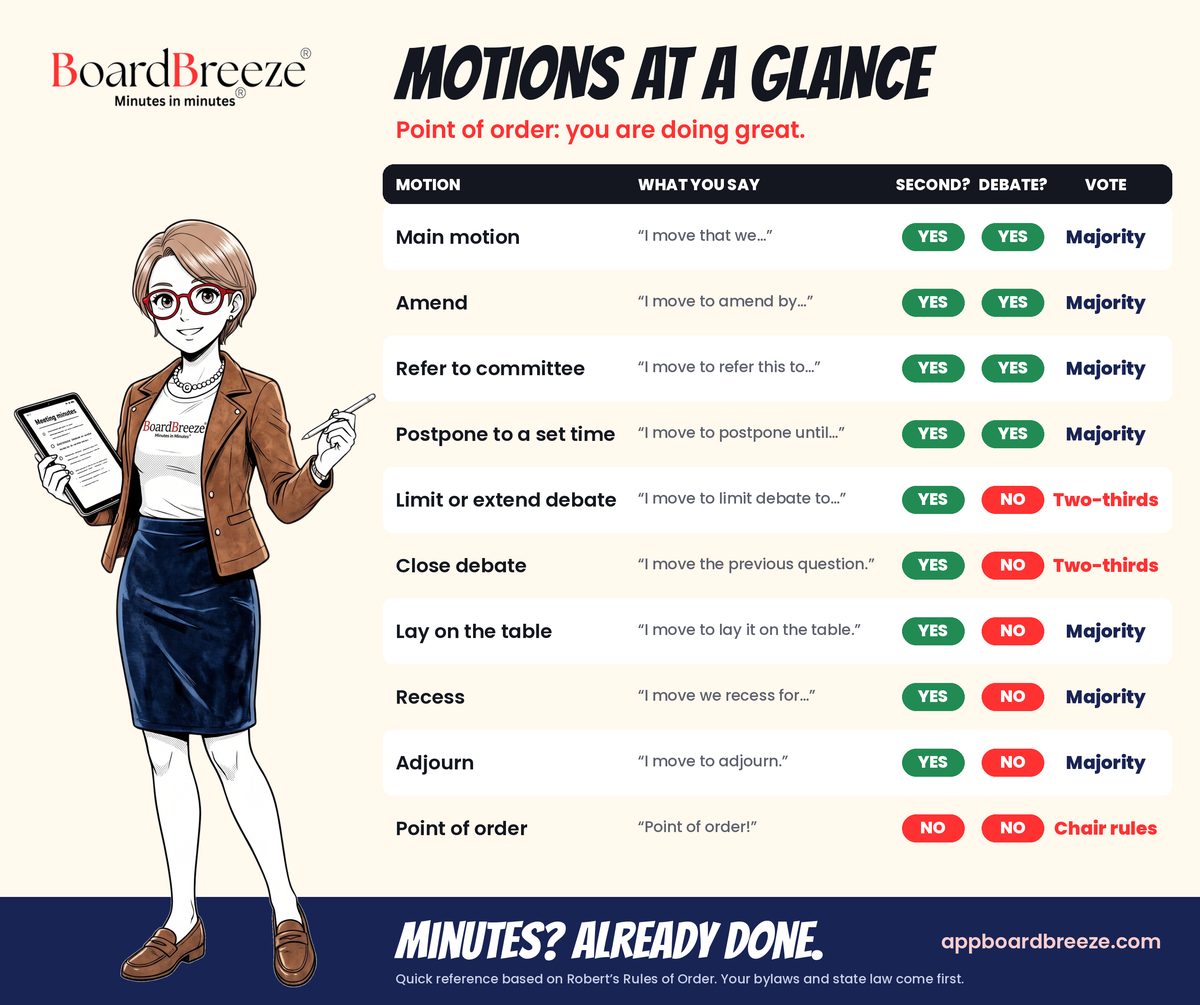
Motions at a Glance (free PDF)
Ten motions. Second, debate, and vote for each. One page.
The chart board clerks keep next to the keyboard for the moment the chair asks “does that need a second?” Based on Robert's Rules of Order. Your bylaws and state law come first.
BoardBreeze®
Stop Taking Minutes By Hand
BoardBreeze® converts your meeting audio into polished, compliant minutes automatically — no dedicated note-taker required.
Start Free 15-Day Trial →Ready to Automate Your Meeting Minutes?
BoardBreeze® turns your board meeting audio into polished, compliant minutes — Minutes in Minutes®, not hours.
Start Free TrialRelated Articles
Ordinance vs. Resolution vs. Motion: What Every City Clerk Needs to Know (2026)
The practical difference between an ordinance, a resolution, and a motion: what each one does, how each is adopted, when each takes effect, and exactly how each should appear in your council minutes.
Committee Meeting Minutes for California Community Colleges: Participatory Governance, Robert's Rules & the Brown Act
Every California community college runs ten or more governance committees — accreditation, budget, facilities, PGC — and each one needs minutes. What committee minutes must include, how the Brown Act applies, why accreditation teams read them, and how to produce them in minutes instead of hours.
Approval of Board Meeting Minutes: Rules & Process
Learn the correct process for approval of board meeting minutes, including Robert's Rules, amendments, corrections, consent agendas, and common mistakes.