
Approval of Board Meeting Minutes: Rules & Process
Learn the correct process for approval of board meeting minutes, including Robert's Rules, amendments, corrections, consent agendas, and common mistakes.
Approval of Board Meeting Minutes: Process, Rules, and Common Mistakes
The approval of board meeting minutes seems straightforward — someone moves to approve, someone seconds, the board votes, done. But in practice, the approval process is one of the most mishandled aspects of board governance. Boards routinely skip steps, confuse corrections with amendments, rubber-stamp inaccurate minutes, or create procedural problems that can invalidate the entire record.
Whether you follow Robert's Rules of Order, your own bylaws, or state statute, getting the approval of board meeting minutes right matters. The minutes are often the only legal record of what the board decided. If the approval process is flawed, the record is flawed.
This guide walks through the correct approval process under Robert's Rules, how to handle corrections and amendments, the consent agenda shortcut, common mistakes, and legal requirements you should know.
Why the Approval of Board Meeting Minutes Matters
Minutes aren't official until they're approved. Before approval, they're a draft — a preliminary record that hasn't been verified by the board. After approval, they become the organization's official account of what happened at the meeting.
This distinction has real consequences:
- Legal standing — approved minutes are presumed accurate in court proceedings, audits, and regulatory reviews. Unapproved drafts carry little weight.
- Member rights — minutes document motions, votes, and decisions that affect member rights. Inaccurate minutes can misrepresent what was actually decided.
- Institutional memory — staff and future board members rely on approved minutes to understand past decisions. If the minutes are wrong and no one catches it during approval, the error becomes permanent.
- Compliance — for public entities, approved minutes are often required to be posted or made available to the public within a specific timeframe. The approval step triggers that obligation.
The Standard Approval Process Under Robert's Rules
Robert's Rules of Order Newly Revised (RONR) establishes the parliamentary standard used by most boards in the United States. Here's the correct process for approval of board meeting minutes under RONR:
Step 1: Distribution Before the Meeting
The secretary should distribute draft minutes to all board members before the meeting where approval will occur. This gives members time to review the minutes, identify errors, and prepare any corrections.
Best practice: distribute minutes at least 3-5 days before the meeting. Handing out minutes at the meeting and asking for immediate approval doesn't give members adequate time to review.
Step 2: The Chair Calls for Corrections
At the meeting, the chair says something like: "The minutes of the [date] meeting have been distributed. Are there any corrections?"
Note: under Robert's Rules, the chair does not ask for a motion to approve the minutes. The standard procedure is to call for corrections first. This is one of the most commonly misunderstood aspects of the approval of board meeting minutes.
Step 3: Members Offer Corrections
Any member can offer a correction without needing a second. Corrections are factual fixes — things that are wrong in the draft minutes:
- A name was misspelled
- A vote count was recorded incorrectly
- A motion was attributed to the wrong person
- An agenda item was omitted
- The time of adjournment was wrong
Corrections don't require a motion or a vote — the secretary simply makes the fix. If there's a dispute about whether something is actually an error, the chair can put the question to the board for a vote.
Step 4: Approval
After all corrections have been addressed, the chair declares: "If there are no further corrections, the minutes are approved as corrected." (Or "as distributed" if no corrections were offered.)
This is called "approval by general consent" — no motion, no second, no vote is needed unless a member objects. If a member objects to approval by general consent, then a formal motion, second, and vote are required.
The Key Point
The standard process under Robert's Rules is: distribute → call for corrections → make corrections → approve by general consent. A formal motion to approve is only needed if someone objects to general consent.
Many boards habitually use a formal motion ("I move to approve the minutes"), which is acceptable but unnecessary. It's not wrong — it's just extra procedure.
Corrections vs. Amendments: An Important Distinction
This is where many boards get confused during the approval of board meeting minutes.
Corrections
A correction fixes something that's wrong in the minutes — the minutes don't accurately reflect what happened. Examples:
- The minutes say the motion passed 5-2, but it actually passed 6-1
- The minutes omit a motion that was made and voted on
- The minutes attribute a comment to Board Member A when Board Member B said it
Corrections are about accuracy. They make the minutes match reality.
Amendments
An amendment changes the substance of the minutes — not because they're inaccurate, but because a member wants them to say something different. For example:
- A member wants to add discussion points that weren't in the original draft
- A member wants to change the characterization of a discussion
- A member wants to remove something that was accurately recorded
Under Robert's Rules, the approval process is specifically for corrections, not amendments. If a member wants to change something that was accurately recorded, that's a separate motion to amend, which requires a second and a vote.
This distinction matters because corrections ensure accuracy, while amendments can alter the historical record. Boards should be cautious about amending minutes for anything other than factual accuracy.
Using a Consent Agenda for Approval of Board Meeting Minutes
Many boards use a consent agenda (also called a "consent calendar") to speed up routine business — including the approval of board meeting minutes.
How It Works
The consent agenda bundles routine, non-controversial items into a single vote. Minutes approval is a common consent agenda item, along with things like committee reports, routine contracts, and standard financial reports.
The process:
- The consent agenda is published with the board packet before the meeting
- At the meeting, the chair asks if any member wants to remove an item from the consent agenda for separate discussion
- If a member wants to discuss or correct the minutes, they request removal
- All remaining consent agenda items are approved in a single motion and vote
- Removed items are discussed and voted on individually
When It Works Well
Consent agendas work for the approval of board meeting minutes when:
- Minutes are distributed well in advance
- Members actually read them before the meeting
- The minutes are generally accurate and non-controversial
When It Doesn't Work
Consent agendas can become a rubber stamp if members don't review materials in advance. If your board routinely approves minutes on the consent agenda without anyone reading them, you have a governance problem — not an efficiency win.
Legal Requirements for Approval of Board Meeting Minutes
Beyond parliamentary procedure, many organizations face legal requirements for minutes approval.
State Open Meeting Laws
Most states require that minutes of public body meetings be approved and made available to the public within a specific timeframe. For example:
- Some states require minutes to be approved at the next regular meeting
- Some states require draft minutes to be posted within a certain number of days, with approved minutes posted after approval
- Some states require minutes to be available for public inspection whether or not they've been formally approved
Know your state's requirements. Failing to approve and publish minutes on time can result in fines or other penalties.
Bylaws
Your organization's bylaws may specify the minutes approval process. Bylaws override Robert's Rules where they conflict. Check whether your bylaws require:
- A formal motion and vote (rather than general consent)
- Approval at the next regular meeting (rather than any subsequent meeting)
- Signatures from specific officers
- Distribution requirements
Record Retention
Once approved, minutes must be retained according to your organization's record retention policy and any applicable laws. Most states require permanent retention of board minutes for public entities. Private organizations should also retain minutes permanently — they're the core institutional record.
Common Mistakes in the Approval of Board Meeting Minutes
Mistake 1: Approving Minutes Nobody Read
The single most common problem. Minutes are distributed at the meeting (or on the consent agenda), no one actually reviews them, and they're approved by default. Errors, omissions, and mischaracterizations become the permanent record.
Fix: Distribute minutes at least 3-5 days before the meeting. The chair should explicitly ask if members have reviewed them.
Mistake 2: Debating Decisions During Minutes Approval
The approval of board meeting minutes is about whether the minutes accurately record what happened — not about whether the board made the right decisions. If a member disagrees with a decision recorded in the minutes, the remedy is to bring a new motion to reconsider — not to amend the minutes.
Fix: If debate starts during minutes approval, the chair should redirect: "The question is whether the minutes accurately reflect what happened, not whether we made the right decision."
Mistake 3: Adding Discussion That Wasn't in the Draft
Members sometimes want to add points they made during the meeting that the secretary didn't capture. While this is a legitimate correction if the point was actually made, minutes should record actions and decisions, not a transcript of discussion. Robert's Rules specifically advises against including extensive discussion in minutes.
Fix: Add the point only if it's material to understanding a decision. Don't turn minutes into a transcript.
Mistake 4: Failing to Correct Minutes Before Approval
If a member identifies an error and the board approves the minutes without addressing it, the error becomes the official record. Under Robert's Rules, corrections can be made to previously approved minutes, but it requires a formal motion and two-thirds vote (or majority with prior notice).
Fix: Address all corrections before the approval vote. Don't move forward with known errors.
Mistake 5: Not Signing or Dating Approved Minutes
Many bylaws and state laws require the secretary (and sometimes the chair) to sign the approved minutes. Unsigned minutes may not be considered official.
Fix: Include a signature line in your minutes template and sign immediately after approval.
Mistake 6: Correcting Already-Approved Minutes Without Proper Procedure
Sometimes errors are discovered after minutes have been approved. Under Robert's Rules, correcting previously approved minutes requires a motion to amend something previously adopted — which requires a two-thirds vote, a majority with previous notice, or a unanimous vote of those present.
Fix: Follow the proper procedure. Don't just quietly edit approved minutes — that undermines the integrity of the record.
How AI Can Improve the Approval Process
Many approval problems stem from poor-quality draft minutes. If the initial draft is accurate, well-organized, and complete, the approval process goes smoothly. If it's rough, incomplete, or poorly formatted, the approval discussion becomes a line-editing session.
AI tools can dramatically improve draft quality. BoardBreeze generates polished, governance-formatted minutes from a recording of the meeting — with proper motions, exact vote records, and structure — so the draft that goes to the board for approval is already close to final.
Because BoardBreeze works after the meeting from a recording you made openly and control, the draft is accurate on the details boards dispute most — exact motion language and vote counts. Uploaded audio is automatically deleted from BoardBreeze's servers within days, and once the minutes are approved, your retention policy closes the loop by deleting the recording — so no parallel verbatim record lingers to conflict with the official minutes.
Conclusion
The approval of board meeting minutes deserves more attention than most boards give it. It's the step that transforms a draft into an official legal record — and getting it wrong can create real problems down the line.
Follow the correct process: distribute early, call for corrections, address them, and approve. Understand the difference between corrections and amendments. Use consent agendas wisely. And start with accurate drafts so the approval process is smooth.
Want approval-ready draft minutes every time? Try BoardBreeze free — AI-generated, governance-quality minutes from your meeting recording, with the audio automatically deleted within days. Just polished minutes ready for board approval.
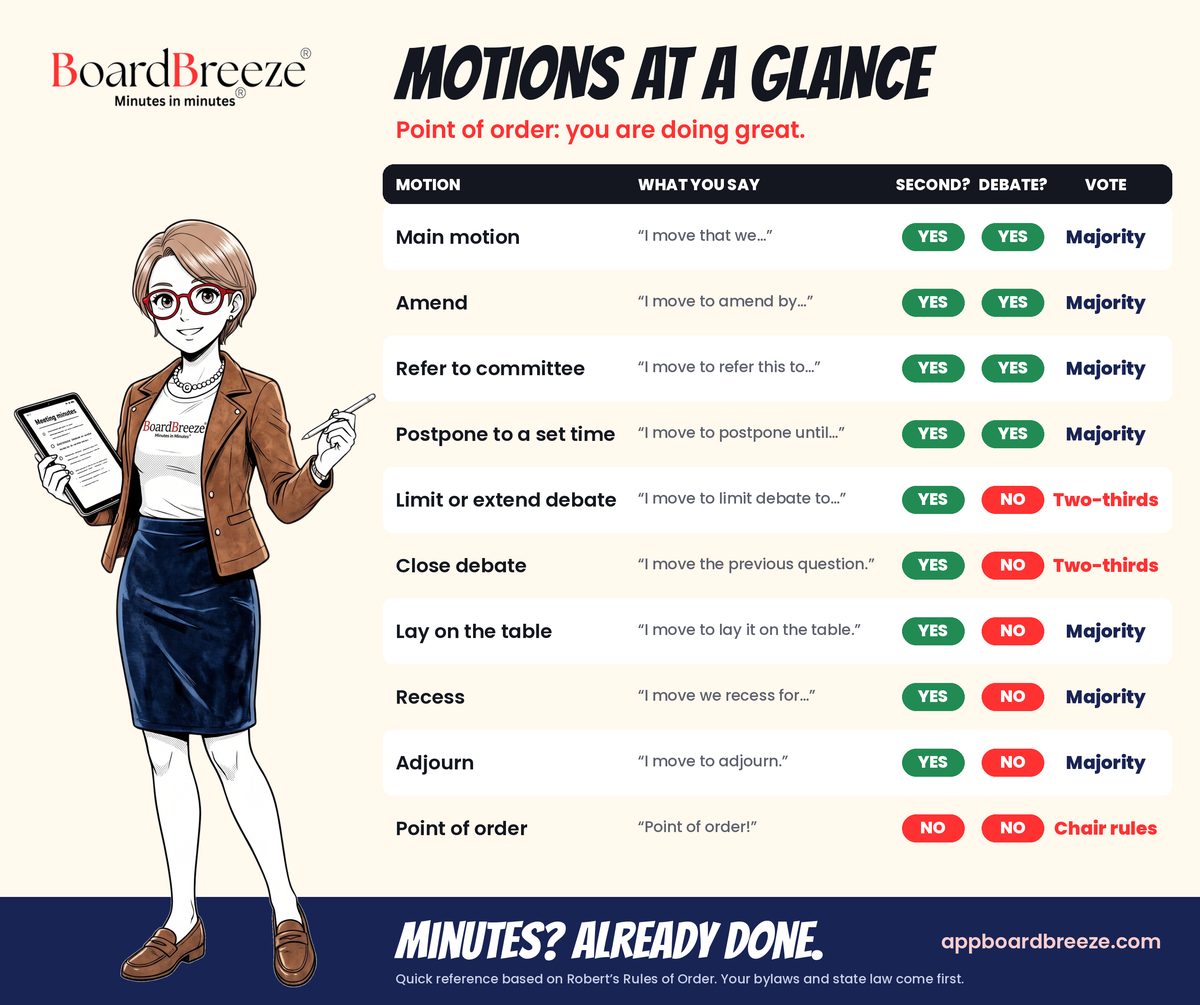
Motions at a Glance (free PDF)
Ten motions. Second, debate, and vote for each. One page.
The chart board clerks keep next to the keyboard for the moment the chair asks “does that need a second?” Based on Robert's Rules of Order. Your bylaws and state law come first.
BoardBreeze®
Stop Taking Minutes By Hand
BoardBreeze® converts your meeting audio into polished, compliant minutes automatically — no dedicated note-taker required.
Start Free 15-Day Trial →Ready to Automate Your Meeting Minutes?
BoardBreeze® turns your board meeting audio into polished, compliant minutes — Minutes in Minutes®, not hours.
Start Free TrialRelated Articles
Ordinance vs. Resolution vs. Motion: What Every City Clerk Needs to Know (2026)
The practical difference between an ordinance, a resolution, and a motion: what each one does, how each is adopted, when each takes effect, and exactly how each should appear in your council minutes.
Committee Meeting Minutes for California Community Colleges: Participatory Governance, Robert's Rules & the Brown Act
Every California community college runs ten or more governance committees — accreditation, budget, facilities, PGC — and each one needs minutes. What committee minutes must include, how the Brown Act applies, why accreditation teams read them, and how to produce them in minutes instead of hours.
Annual Board Meeting Minutes: What to Include
Learn what to include in annual board meeting minutes, from officer elections to financial reports. Get a template and tips for accurate, compliant minutes.